
For investors · the moat, plainly
Go ahead.
Copy the software.
Any good team can rebuild an app in eighteen months. Then they hit the four walls — the memory, the clearance, the position, and the loop — and eighteen months becomes never.
01 The four walls
What a competitor
actually needs.
Not features. Features are eighteen months. These are the things you cannot sprint your way into — listed in the order they will stop you.
wall 01 · the memory
Payer behavior you can't buy
How BCBS actually pays CO-16 — 51%, median 34 days — isn't in any database you can license. It's learned from 80M+ claims※CMS CRUSH RFI response · 2025 of live 835 traffic, versioned by jurisdiction and date of service. You only get this data by operating where the money moves.
to replicate · operate at scale for years — and your customers must let you keep the lessons
wall 02 · the clearance
Authorization you can't rush
FedRAMP High and a national VA Authority to Operate — 421 NIST controls※public authorization record, running against VistA, Cerner, and Epic in production. We did it in under 18 months※VA authorization record; that is close to the speed limit.
to replicate · 18–36 months, if you are flawless — and most never finish
wall 03 · the position
Trust you can't fake
We run payer-side, provider-side, and federal — simultaneously, in production. That's what makes the number objective: both sides accept it because neither side owns us. Every incumbent is structurally one-sided; their economics collapse if they switch.
to replicate · fire half your revenue base — the one-sided business model is the cage
wall 04 · the loop
Ground truth that compounds
Every filed packet comes back paid or denied — a labeled outcome that retrains the genome. 72% appeals won vs. 38% industry※CMS CRUSH RFI response · 2025 isn't a feature; it's the compounding read-out. The gap widens every cycle we operate and they don't.
to replicate · impossible from behind — outcome data only accrues to whoever does the work
the software took two years — the walls took the walls
legacy RAC / ZPIC
Post-payment sampling. Compliance lens only. Recoupment letters, years late.
data-fusion platforms
Aggregate data into dashboards. Analyst-dependent. Visibility, not action.
curaclaims
Prepayment. Every claim. Same engine, both sides. Signed package <5 min.
02 Built to be inevitable
Speed compounds
into infrastructure.
Contracted anchors de-risk the curve — federal and commercial deployments already live, expansion compounding as governance clears. State and federal programs follow a land-once, scale-everywhere model, built to the standard we proposed to CMS.
The business model matches the moat: results as a service — contingency on recovery, per-claim on prevention. Revenue tied to finished work, not seats. Competitors can't follow without abandoning their own economics.
03 The bench
Defense. Intelligence.
Biotech. Public health.
People who have run the largest payer in America, the largest state health agency, military health operations, and genomic science — aimed, together, at healthcare's plumbing. Full bios →
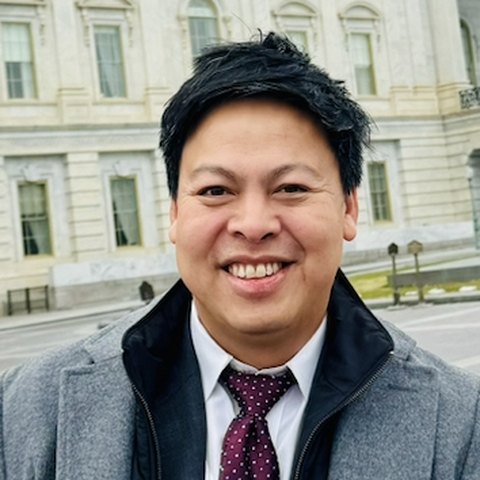
Long Nguyen
Co-founder · CEO

C. Rockefeller
Co-founder · capital

Dr. S. Mukherjee
Co-founder · physician-scientist

Dr. Ed Ellison
Advisor · ex-co-CEO, Permanente

Dr. Mark Ghaly
Advisor · ex-Sec., CA HHS

Wallace Smith
Colonel (ret.), U.S. Army
Qualified investors
The numbers behind the walls.
Detailed financials, unit economics, and pipeline are shared under NDA. Combined customer + pipeline footprint exceeds $250B in annual medical claims.